AI verification takes up a quarter of finance’s time, and that one figure says a lot about where AI stands in the office of the CFO today. Finance teams spend an average of 26% of their workweek checking, correcting, and re-running what their AI tools hand back. And this is happening even though every finance leader in Datarails’ 2026 CFO Sentiments Survey already uses AI in some form.
The study was fielded online by Global Surveyz Research in July 2026 and gathered responses from 270 U.S. CFOs and finance leaders at organizations with more than 1,000 employees and at least $100 million in annual revenue. Its takeaway is simple: adoption is no longer the hurdle. AI trust is.
Here’s what the survey found, why finance teams verify AI outputs so heavily, and what it takes to lighten the AI review burden without lowering the bar on AI financial accuracy.
AI Verification Takes Up a Quarter of Finance’s Time
The headline number is an average, and the distribution behind it is just as revealing:
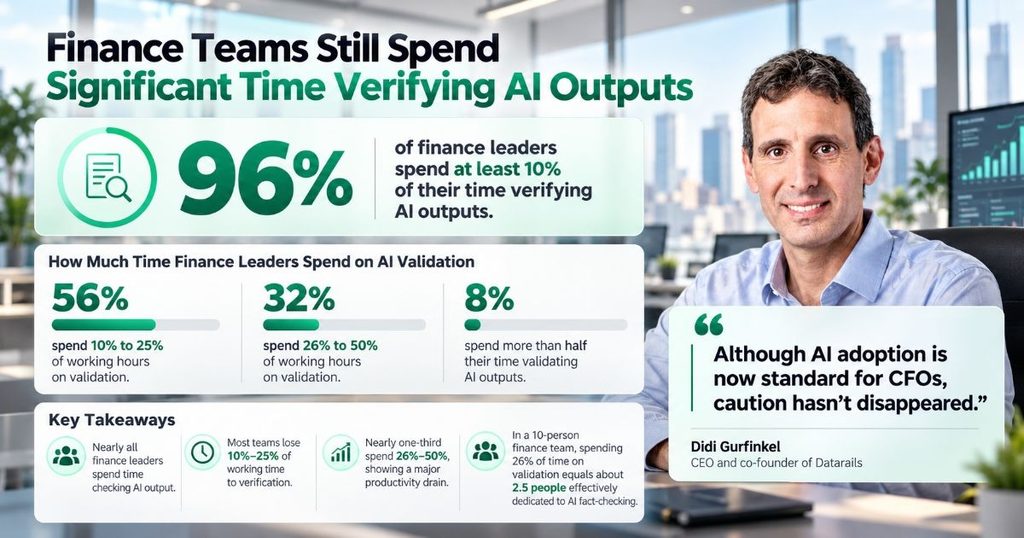
96% of finance leaders spend at least 10% of their time verifying AI outputs.
56% spend between 10% and 25% of their working hours on it.
32% spend between 26% and 50%.
8% spend more than half their time on AI output validation.
To put that in perspective, a ten-person finance team spending 26% of its hours on verifying AI outputs is effectively dedicating about two and a half people to AI fact-checking full time. “Although AI adoption is now standard for CFOs, caution hasn’t disappeared,” said Didi Gurfinkel, CEO and co-founder of Datarails.
The AI Productivity Paradox
The report itself raises an uncomfortable question: are the gains from AI productivity at risk of being canceled out, and are finance professionals heading toward burnout from endless rounds of quality assurance? Finance team burnout is a real concern when skilled analysts spend their days checking AI-generated data instead of interpreting it.
The paradox shows up in budgets, too. The survey notes that AI hallucinations and inconsistent answers often force multiple prompts to reach a usable result, which quietly drives up token costs. Nearly a third of organizations (32%) overshot their AI budgets by at least 10% in the past year. Even so, 53% plan to expand AI licenses over the next 12 months, and only 7% are cutting back, so the AI verification workload is likely to grow alongside usage unless something changes.
Why CFOs Don’t Fully Trust AI?
When asked what holds them back from handing mission-critical work to AI, finance leaders pointed to three barriers:
Lack of AI auditability (75%), the single biggest obstacle.
Concerns about AI accuracy and hallucinations (71%).
Regulatory or compliance concerns (54%).
Beyond those headline barriers, the survey digs into the day-to-day frustrations that create the AI trust gap in the first place.
AI Auditability: Where Did This Number Come From?
More than half of respondents (51%) have been unable to explain or trace how an AI tool arrived at a figure. In finance, an answer without a trail is not an answer. Whether the question comes from the CEO, the board, or an external auditor, finance has to show its work, and AI-generated financial data that can’t be traced back to a source fails that test by default.
AI Hallucinations and Confident Wrong Answers
The most common frustration, cited by 65% of CFOs, is AI giving confident answers built on the wrong data. That is what makes AI hallucinations so dangerous in finance: wrong AI answers rarely look wrong. In finance, being 99% right effectively means being wrong, so a single inaccurate AI output in a forecast or board deck can undermine the credibility of everything around it.
AI Output Inconsistencies From the Same Prompt
56% of respondents say team members have received materially different LLM outputs using the same prompt and the same data. Unreliable AI outputs like these explain another finding:
Finance teams run an average of 2.5 general-purpose LLMs, often using one to check the other.
Microsoft Copilot leads usage at 93%, followed by ChatGPT (65%) and Claude (64%).
Cross-checking one model with another can catch AI inconsistencies, but it also adds yet another layer of review.
Human Review Still Gates Almost Every Finance Task
The trust gap is clearest when you look at which tasks CFOs are willing to leave to AI without human review. The answer: mostly the low-stakes ones. Drafting emails (89%) and meeting summaries (84%) top the list. Core finance work is another story:
Revenue forecasting: 23%
Variance analysis: 13%
Cash flow management and spend control: 11%
Board-ready financial reports: 5%
Month-end close tasks: 4%
Another 3% wouldn’t accept AI’s final output on any financial task without a human checking it. For AI accuracy in financial reporting, human oversight remains the safety net, and that safety net is exactly what consumes a quarter of the week.
Poor Data Quality for Finance AI Fuels the Review Burden
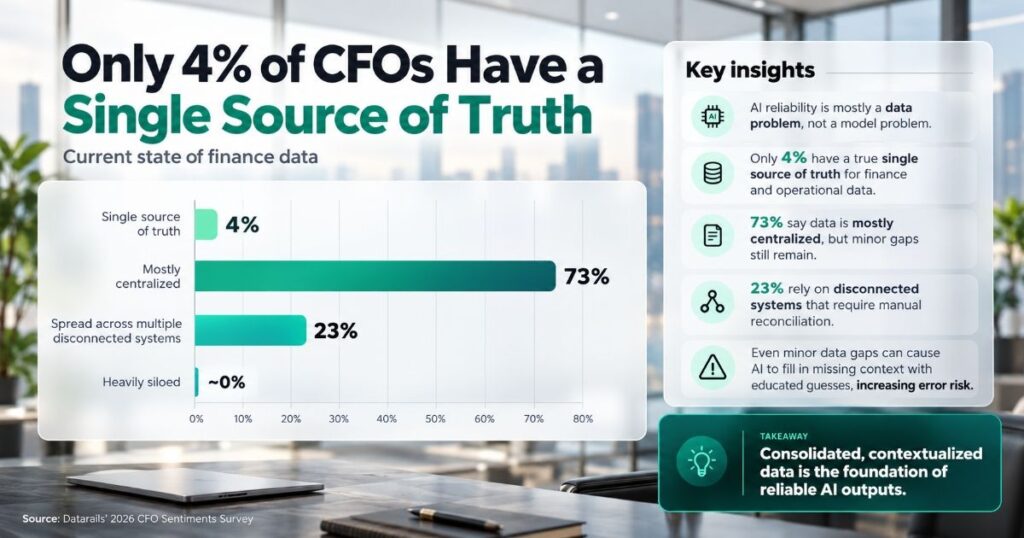
The survey makes a strong case that AI reliability is mostly a data problem, not a model problem. AI needs consolidated, contextualized data to produce reliable AI outputs, yet only 4% of organizations have a true single source of truth for finance and operational data. Most (73%) describe their data as “mostly centralized” with minor gaps, and 23% rely on disconnected systems that require manual reconciliation.
Those “minor gaps” matter more than they sound. As the report points out, probabilistic AI tends to fill blank spaces with educated guesses, which is how AI-generated errors slip into otherwise polished outputs.
Disconnected Systems Double AI Verification Time
Among teams with data spread across disconnected systems, 76% spend more than a quarter of their time on AI verification. For teams with mostly centralized data, that share drops to 31%. Few findings show more clearly how directly AI data accuracy depends on consolidation.
Manual reporting and data consolidation is the single biggest operational challenge for finance teams (32%), followed by the inability to produce ad-hoc analysis fast enough for leadership (19%). The link to AI output accuracy is direct: among CFOs dealing with heavy manual reporting and consolidation, 86% have experienced wrong AI answers, compared with 65% overall.
Pressure to Adopt Is Outpacing AI Readiness
Three-quarters of CFOs (76%) face high or very high pressure to fully implement AI, a sharp turn from the “tread with caution” mood of the previous survey. But readiness hasn’t kept pace. Only 7% say their finance function is fully ready to deploy AI across all workflows. Another 71% feel “mostly ready” but cite gaps in governance and auditability, and 22% are only “partially ready.”
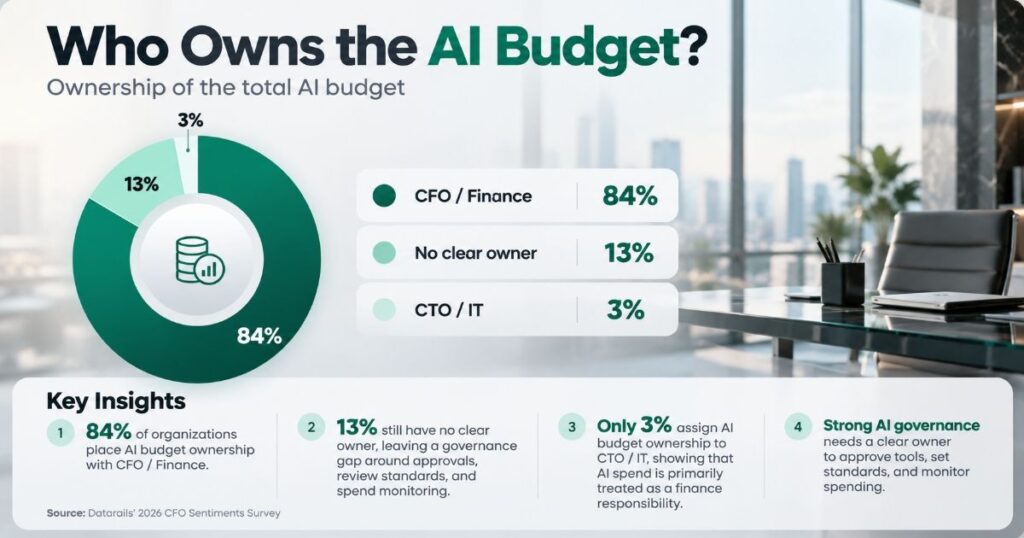
AI governance has its own blind spot. While 84% of CFOs own their organization’s AI budget, 13% of companies report no clear owner at all, leaving roughly one in eight at risk of AI costs and controls drifting.
How to Reduce AI Hallucinations in Finance and Review Time
The survey points to a clear conclusion: finance teams can’t review their way out of this problem. Lasting relief comes from fixing what feeds the AI and building checks into the workflow.
Build AI-Ready Financial Data First
AI-ready financial data means consolidated, governed, and consistently defined numbers. A semantic layer that locks in KPI definitions helps every model, and every user, work from the same business language. This is why a new category is gaining ground: a finance operating system, or a governed data layer that delivers consistent, audit-ready, AI-compatible numbers. Datarails introduced FinanceOS in March 2026, and within months, 32% of CFOs ranked a finance operating system as their next technology priority, second only to planning and FP&A tools (42%).
Demand is coming from two directions. Among CFOs whose top challenge is manual reporting and consolidation, 49% are prioritizing one. Among those struggling to keep up with the pace of AI change, 50% are doing the same.
Make Traceability a Non-Negotiable
Since auditability is the top trust barrier, every AI output used in decision-making should link back to its source data and logic. When reviewers can trace a number in seconds, financial data verification becomes a quick confirmation rather than a full rebuild.
Match Human Review to the Risk
Not every output needs the same scrutiny. A practical approach to how finance teams check AI outputs is to tier review: light spot checks for drafts and summaries, structured AI validation for forecasts and variance analysis, and full sign-off for anything board-bound or close-related. This keeps human oversight where it counts and frees time elsewhere.
Assign Clear AI Governance Ownership
Strong financial data governance needs an owner. Defining who approves AI tools, sets review standards, and monitors spend closes the gap that 13% of organizations still leave open.
AI Verification Drains Productivity, Not Headcount
The good news: the layoffs many CFOs expected in the previous survey haven’t materialized. 60% are redeploying staff to higher-value work as AI takes on routine tasks, and only 3% are cutting headcount where AI has replaced work. “Fears of job losses have been largely allayed, but the challenge of AI output verification is critical,” Gurfinkel said.
That’s the real opportunity. Every hour spent correcting AI outputs is an hour not spent on analysis, strategy, and business partnering, the work finance teams were hired to do.
Closing the AI Trust Gap Starts With AI-Ready Data
The survey shows that finance has moved past whether to use AI and into the harder question of how to trust it. Today, AI verification takes up a quarter of finance’s time because AI tools are running on fragmented data with limited traceability. Teams that invest in AI-ready data, clear governance, and risk-based human review will be the ones that turn AI from a source of extra checking into a genuine productivity engine.
Get the next guide by email
Occasional, practical notes on AI, automation, FP&A and Excel.